Hebrews 10:26-27 – For if we sin wilfully after that we have received the knowledge of the truth, there remaineth no more sacrifice for sins, But a certain fearful looking for of judgment and fiery indignation, which shall devour the adversaries.
Remark: This passage is often understood to mean that if we sin knowingly—fully aware of what we are doing, and perhaps even wanting to do it in the moment—then the consequences described there will apply. But let us examine more closely whether this interpretation truly aligns with the broader biblical context.
If you have ever read a book from the nineteenth century or earlier, you will quickly notice that authors used many of the same words we use today, but often in a different way—meaning different things. The meanings of words change over time, so it is important to get the definitions straight. But before we come to the definition of the word “willful,” let us try to understand the Bible without imposing our definitions on it.
The story of denial
What does the Bible say about denying Jesus?
2 Timothy 2:11-13 – It is a faithful saying: For if we be dead with him, we shall also live with him: If we suffer, we shall also reign with him: if we deny him, he also will deny us: If we believe not, yet he abideth faithful: he cannot deny himself.
Remark: Those who deny Jesus will be denied by Him; therefore, they will experience what is described in Hebrews 10:26–27.
What did Peter do regarding Jesus, and what was the response?
John 18:25, 27 – And Simon Peter stood and warmed himself. They said therefore unto him, Art not thou also one of his disciples? He denied it, and said, I am not. / [27] Peter then denied again: and immediately the cock crew.
Remark: Peter denied Jesus (see also Matthew 26:69–75; Mark 14:66–72; Luke 22:54–62). We could say that he did so willingly, because he was fully aware of what he was doing and made a deliberate choice.
John 21:12, 17, 19b – Jesus saith unto them, Come and dine. And none of the disciples durst ask him, Who art thou? knowing that it was the Lord. / [17] He saith unto him the third time, Simon, son of Jonas, lovest thou me? Peter was grieved because he said unto him the third time, Lovest thou me? And he said unto him, Lord, thou knowest all things; thou knowest that I love thee. Jesus saith unto him, Feed my sheep. /[19b] And when he had spoken this, he saith unto him, Follow me.
Recommended article: From Denial to Devotion – How Jesus Restores the Fallen
Remark: Jesus provided Peter—and the other disciples—with nourishment, both physical and spiritual. He called Peter to serve and follow Him. This stands in stark contrast to 2 Timothy 2:12, which says that He will deny those who deny Him. Even though Peter denied Jesus, his restoration shows that he did not deny Him in the sense described in verse 12, but rather as described in the next verse, 2 Timothy 2:13.
What is often the cause of our denial and sin?
2 Timothy 2:11-13 – It is a faithful saying: For if we be dead with him, we shall also live with him: If we suffer, we shall also reign with him: if we deny him, he also will deny us: If we believe not, yet he abideth faithful: he cannot deny himself.
Remark: It is our unbelief, or lack of faith. Peter lacked faith, but Jesus remained faithful. A lack of faith is a weakness (e.g. Romans 14:1) rather than a deliberate resistance to believing.
Raised or hanging hand
How is the sin of rebellion described in the OT?
Numbers 15:30-31 – But the soul that doeth ought presumptuously {that does this with a raised hand}, whether he be born in the land, or a stranger, the same reproacheth {blasphemes} the Lord; and that soul shall be cut off from among his people. Because he hath despised the word of the Lord, and hath broken his commandment, that soul shall utterly be cut off; his iniquity shall be upon him.
Remark: In the Old Testament, the concept of acting with a “raised hand” (translated here as a “presumptuous” act) refers to a bold and defiant gesture. The same Hebrew expression appears in Exodus 14:8 and Numbers 33:3. In the context of the Exodus story, Pharaoh exemplifies this spirit of defiance in Exodus 5:2, even though the phrase is not directly applied to him. When committed against God, such an act is considered a reproach to the Lord, expressing hatred and contempt toward Him. In contrast to raising your hand in defiance is letting your hand down in discouragement.
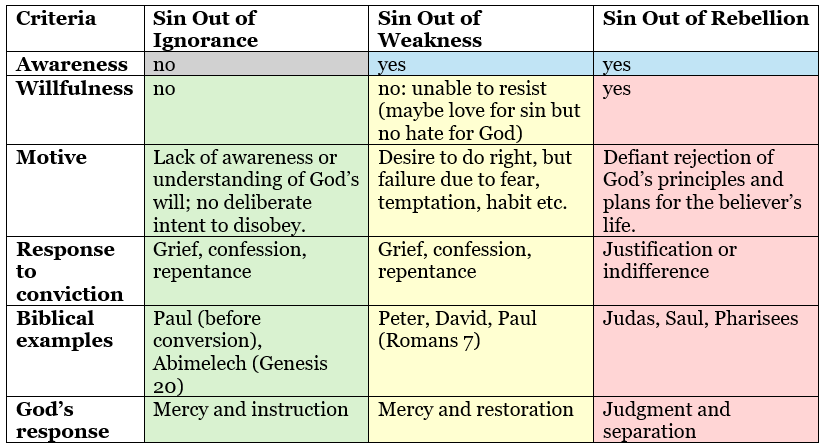
Numbers 15, beginning in verse 22, addresses sins committed out of ignorance—actions done without awareness. This shows that there are at least three different kinds of sin: sins of ignorance, weakness, and rebellion.
How can we distinguish between different types of sin?
Remark: For God, it is easy to see if and how we have sinned—He only needs to look into our hearts (see 1 Chronicles 28:9; 1 Samuel 16:7). But for us there are at least two distinguishing marks.
Matthew 26:41 – Watch and pray, that ye enter not into temptation: the spirit indeed is willing, but the flesh is weak.
Remark: The first distinguishing mark is intent. For God, the intention of the heart—of the spirit or mind—matters, even when we are too weak to subdue the flesh. In this passage, Jesus also reveals how we can remain strong and avoid sins of weakness: by watching (being mindful and careful) and praying (frequently).
2 Samuel 12:13, 16 – And David said unto Nathan, I have sinned against the Lord. And Nathan said unto David, The Lord also hath put away thy sin; thou shalt not die. / [16] David therefore besought God for the child; and David fasted, and went in, and lay all night upon the earth.
Remark: The second distinguishing mark is whether there is repentance. David’s sin was not only willful but also planned. However, it stemmed from his weakness for women and lust, not from rebellion against God. His genuine repentance, as expressed in Psalm 51, shows that his sin was not rooted in defiance. Saul, by contrast, justified himself instead of repenting (see 1 Samuel 15).
Can we see these criteria in Peter’s and Judas’ actions?
John 13:37 – Peter said unto him, Lord, why cannot I follow thee now? I will lay down my life for thy sake.
Matthew 26:14-16 – Then one of the twelve, called Judas Iscariot, went unto the chief priests, And said unto them, What will ye give me, and I will deliver him unto you? And they covenanted with him for thirty pieces of silver. And from that time he sought opportunity to betray him.
Remark: Peter was willing to give his life for Jesus, which expressed his intent to remain loyal and obedient to Him. He even acted on this intention in an unwelcome way when he drew a sword and cut off the ear of one of the servants sent to capture Jesus (John 18:10–11). Judas, on the other hand, was actively plotting to betray Jesus, which shows that he did not merely fall out of a lack of faith.
Luke 22:62 – And Peter went out, and wept bitterly.
Matthew 27:5 – And he {Judas} cast down the pieces of silver in the temple, and departed, and went and hanged himself.
Remark: The text shows that Peter repented of his sin. Judas, while exhibiting regret, did not truly repent. True repentance involves letting God lead us through the consequences of our sins (as David did), but Judas decided to end it all on his own terms.
Whereas Judas acted “with a raised hand” in defiance of who Jesus was and in accordance with his own selfish desires, Peter acted with a “hanging hand”, in fear and discouragement.
Willfully
What does “willfully” in Hebrews 10:26 mean?
1 Peter 5:2 – Feed the flock of God which is among you, taking the oversight thereof, not by constraint, but willingly; not for filthy lucre, but of a ready mind …
Remark: The word translated as “willfully” in Hebrews 10:26 appears a second time in the New Testament in 1 Peter 5:2. It does not simply mean “knowingly” or “with intent,” since Peter contrasts two situations in which a person acts with full awareness and deliberation. Rather, the distinction lies in whether the action is compelled by external factors (constraint) or stems from intrinsic motivation (of a ready mind). Only if we choose to rebel against God and His Son are we in danger of sinning “with the raised hand.”
How, then, should we understand Hebrews 10:26?
Hebrews 10:26-29 – For if we sin wilfully {with a raised hand} after that we have received the knowledge of the truth, there remaineth no more sacrifice for sins, But a certain fearful looking for of judgment and fiery indignation, which shall devour the adversaries. He that despised Moses’ law died without mercy under two or three witnesses: Of how much sorer punishment, suppose ye, shall he be thought worthy, who hath trodden under foot the Son of God, and hath counted the blood of the covenant, wherewith he was sanctified, an unholy thing, and hath done despite unto the Spirit of grace?
Remark: Those who reach a state of absolute rebellion and hardness of heart will be lost. Raising your hand against God is the so-called unpardonable sin (sin against the Spirit of grace). It is unpardonable because the sinner cuts himself off from God and His Son—the only means by which pardon can reach him.
Did I commit the unpardonable sin with a raised hand?
Daniel 4:34, 37 – And at the end of the days I Nebuchadnezzar lifted up mine eyes unto heaven, and mine understanding returned unto me, and I blessed the most High, and I praised and honoured him that liveth for ever, whose dominion is an everlasting dominion, and his kingdom is from generation to generation … / [37] Now I Nebuchadnezzar praise and extol and honour the King of heaven, all whose works are truth, and his ways judgment: and those that walk in pride he is able to abase.
Remark: You did not commit the unpardonable sin if you still care about whether you did. Those who have committed it are not bothered by this question. Nebuchadnezzar seems to have acted in absolute defiance toward God: he did not truly believe Daniel even after acknowledging the power of God (Daniel 2:47); he made a golden idol and forced the Jews to worship it and even tried to throw them into a furnace for refusing to do so, and then acknowledged that Jesus rescued them (Daniel 3:28). He then continued to defy God when Daniel appealed to him in Daniel 4:27. Yet what appears to us to be clear rebellion with a raised hand still did not cross the line for God, because God is so merciful and understanding.
What other encouraging words does the Bible give us?
1 John 1:9 – If we confess our sins, he is faithful and just to forgive us our sins, and to cleanse us from all unrighteousness.
Hebrews 4:15 – For we have not an high priest which cannot be touched with the feeling of our infirmities {weaknesses}; but was in all points tempted like as we are, yet without sin.
Proverbs 24:16 – For a just man falleth seven times, and riseth up again: but the wicked shall fall into mischief.
Remark: See also Psalm 103:13-14 and 2 Corinthians 8:12.
Appendix: Types of sin